
When Did Payments Become a Revenue Strategy?
For banks, payments have never been just infrastructure. They have always been a source of revenue. What is changing is who gets to participate in that revenue.
As payment infrastructure opens up to non-bank participants and new payment mechanisms enter the market, more organisations are becoming part of the payment value chain. Payment service providers, infrastructure companies and other ecosystem participants now compete for a share of value that has historically sat largely within banking.
For merchants the conversation has traditionally been very different. Payments are treated as a cost of doing business, a line item to be negotiated downwards. That framing leaves most of the picture out.
A payment is more than a transaction fee
IFor a merchant the logic looks straightforward. A customer buys something, the business receives the payment, a fee is deducted, and the remainder becomes revenue.
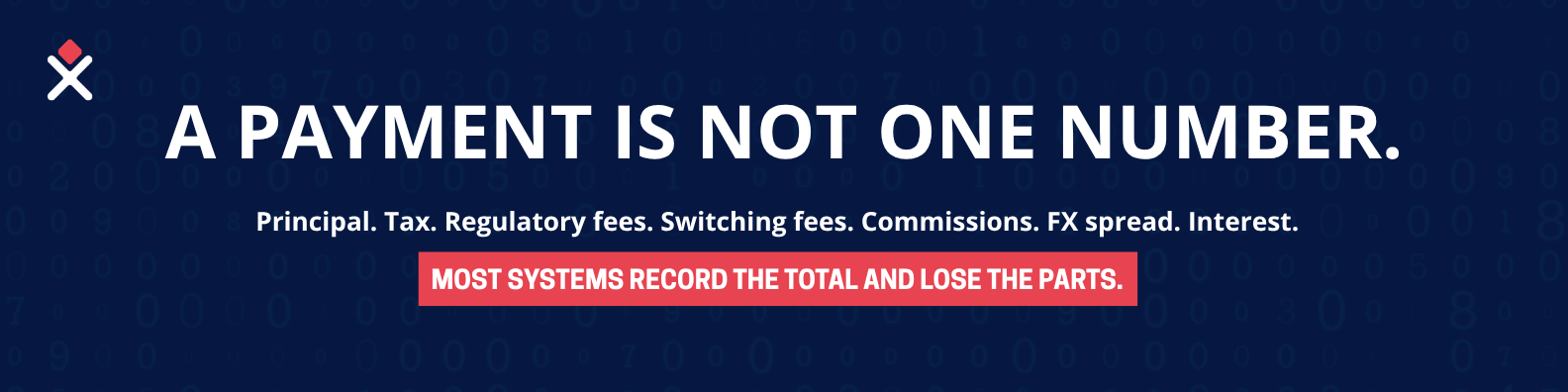
The payment itself contains far more than that. Alongside the principal amount sit tax, regulatory fees, switching fees, supplier or partner commissions, foreign exchange spreads, interest, and other charges and revenue components. Each belongs to someone. Each has a different commercial character.
Payment systems have generally not been designed to make those components visible as separate facts. They treat the payment as one blended amount, which makes some fundamental questions difficult to answer:
- What is the actual cost of processing this payment?
- Which components generate revenue rather than cost?
- Which costs belong to the merchant, and which to a provider or another participant?
- Where are margins being affected, and by which payment methods?
- How does the cost of a particular payment method compare with the value it creates?
This is not an accounting problem. It is a visibility problem. Without the underlying detail, commercial decisions about payment methods, providers and pricing are made on a blended number rather than on the economics underneath it.
The economics of payments are shifting
For decades banks have occupied the central position in payment infrastructure and captured a large share of the value generated by payment activity. That position is changing.
Opening national payment infrastructure to non-bank participants creates room for payment service providers and infrastructure businesses to participate more directly in the payment value chain. At the same time, merchants face a widening set of payment mechanisms. Cards remain central, but digital wallets, QR-based payments, buy now pay later and other models are now real options rather than experiments.
That creates choice, and choice creates complexity. Every new payment mechanism raises questions about integration, pricing, customer experience, settlement timing and the effect on margin. For a merchant the decision can no longer be whether a payment method can be accepted. It has to be what accepting that method means for the business.
The merchant sits in the middle of a changing ecosystem
A payment is no longer a relationship between a customer, a merchant and a bank. More participants are involved in moving, processing, routing and settling money, and each one changes the economics of the transaction.
A merchant may be making the sale, but the payment journey can pass through several providers and infrastructure layers before the money reaches its destination. That creates both cost and opportunity. The difficulty is telling them apart.
If the payment record does not show what happened inside the transaction, the merchant knows the amount received without understanding the economics that produced it. Knowing what you received is not the same as understanding what happened.
Payment strategy belongs closer to commercial strategy
Payment decisions influence more of the business than most organisations account for.
Revenue
How easily customers can complete a purchase, and which payment models create additional value rather than only cost.
Margin
The real cost of different payment mechanisms and infrastructure providers, once every component is visible.
Customer experience
The friction, speed and choice presented at the point of payment.
Operations
The work involved in integrating, reconciling and managing multiple payment environments.
Future flexibility
The ability to participate in new payment ecosystems without rebuilding every time the market shifts.
For that reason payment strategy should sit alongside commercial strategy rather than inside a technology or finance workstream. The question is not only how cheaply a business can process a transaction. It is whether the organisation understands the full economic picture behind it.
From processing payments to understanding them
There is a difference between processing a payment and understanding it.
Processing asks whether the transaction happened. Understanding asks what happened inside it: who created value, who incurred cost, and what that means for the business.
The second question becomes more important as payment ecosystems open up and more participants enter the market. It also changes what payment infrastructure is for. The objective is not to add more payment options. It is to build an environment where an organisation can see, manage and respond to the economics of the options it already has.
The question businesses should be asking
Payments are not the final step in a sale. They are part of the economics of the sale. The first step towards treating them as a commercial lever is being able to see what is actually happening
Look inside your own payment economics
If your business can see what a payment cost but not what it contained, that is where the work starts.
Speak to the Causal Nexus team about the visibility and orchestration layer around your existing payment environment.